In short
The signal that matters
- Everyone is talking about an AI chief of staff as the right hand for running the business.
- A common mistake: “right hand” means doing everything.
- If your AI chief of staff is always busy, it can’t talk to you or take more off your plate.
- The job is triage, dispatch, close the loop, and report when work is done.
- Your job as owner is to build the framework so that chief of staff has the knowledge to dispatch well: right agent, clear process, loop closed.
Everyone wants an AI chief of staff as their right hand
Everyone’s talking about an AI chief of staff as the right hand for running the business. Founders hear the phrase and picture relief: finally someone (or something) sits next to you, catches what falls, and keeps the operation moving when you’re on a client call or closing a deal. That picture’s right. The version most people build isn’t.
The mistake: treating “right hand” as doing everything
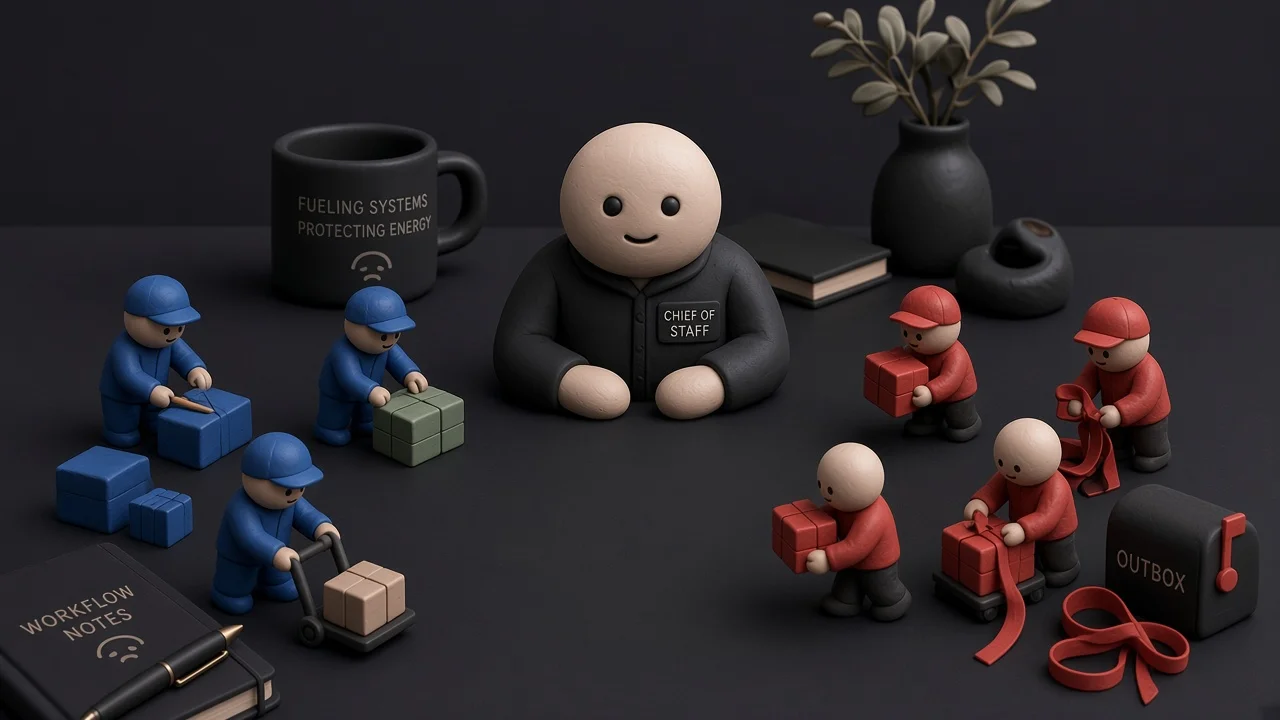
A common mistake is treating “right hand” as a license to do everything. The chief of staff starts writing the outreach in ChatGPT, rewriting the deck in Claude, debugging a workflow in Cursor, spinning a research pass in Grok, handing a browser job to Manus, or parking a long-running task in OpenClaw. Those tools can be useful. None of them is the chief of staff’s job. The moment that seat absorbs craft, it isn’t available to you anymore. It turns into another overloaded agent with a fancy title.

The Hard Knocks lesson that stuck
I didn’t invent this from a slide. At a School of Hard Knocks live event, a millionaire mentor put it in plain English. He said he doesn’t run his calendar and often doesn’t even know what he’s supposed to be doing next, because he’s got a chief of staff who’s always available. She doesn’t live inside a packed calendar the way a founder does. They grew and scaled her role so she’s got her own chief of staff to delegate to, which is how she stays free for him. That session sat in the back of my mind for a long time. I didn’t build my method from that talk alone. The framework clicked later, when I was debriefing my own AI team for weak performance, and that Hard Knocks conversation came back hard.
The technical feedback was simple and ugly. When one agent’s busy doing or chatting through someone else’s work, it diverts. It can’t close the loop. Follow-ups stall. Ownership gets muddy. The thread you thought was “handled” comes back half-finished because the agent that should’ve routed it was stuck inside the work itself. That’s when the Hard Knocks line stopped being a nice story and became an operating rule. The chief of staff isn’t the hero who finishes every deliverable. The chief of staff is the dispatcher and router who hears “this needs to be done,” takes the job, moves it to the right place, and stays available for the next one.
If your AI chief of staff is always busy, it can’t help you
If your AI chief of staff is always busy, it can’t talk to you or take more off your plate. Availability is the product. You want a seat you can interrupt with the next fire, the next lead, the next decision, without waiting for a craft task to finish. When that seat’s buried inside Cursor tickets, ChatGPT drafts, Claude edits, Grok research, Manus runs, or OpenClaw queues, you’re back to being the bottleneck. Hot work cools while you wait for your “right hand” to free up.
The real job: triage, dispatch, close the loop
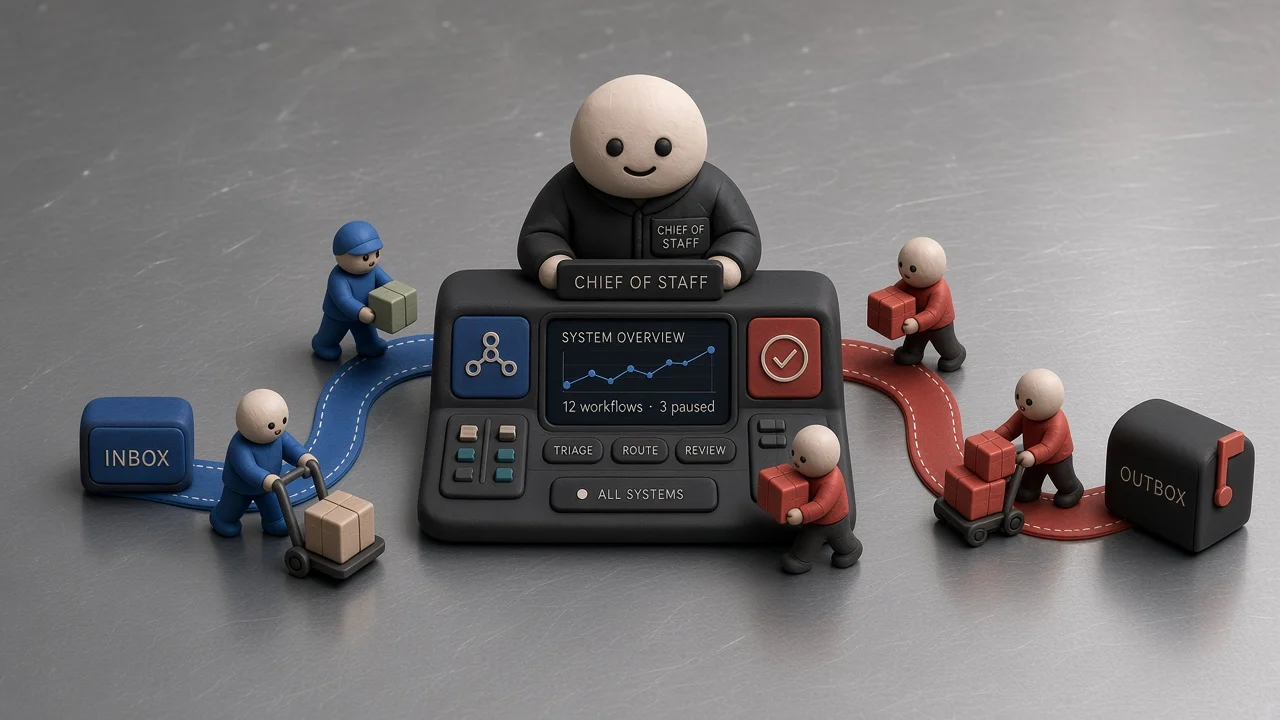
The real job is triage, dispatch, close the loop, and report when work is done.
- Triage — Deciding what matters and what can wait.
- Dispatch — Sending the work to the right agent or person with a clear brief and a clear definition of done.
- Close the loop — Chasing until the result is back, checked, and either finished or returned with a specific gap.
- Report when it’s done — You hear the outcome without hunting for it.
That pattern holds whether your stack is Cursor, ChatGPT, Claude, Grok, Manus, OpenClaw, or a mix. The tools change. The seat doesn’t.
Your job: build the framework so it can dispatch
Your job as the business owner is to build the framework so that chief of staff has the knowledge to dispatch well. Give it the map of who owns what, the standards that define “good,” the process that says how a task moves, and the rule for when something comes back to you. Right agent. Clear process. Loop closed. Without that framework, even a strong model becomes a busy amateur. With it, the chief of staff stays the least busy agent on purpose, because busy craft was never the point.

In fact, my chief of staff knowledge docs have a motto embedded in them: if I’m doing another agent’s job, I’m failing mine.
I’m here to help
If your AI chief of staff is the busiest seat in the room, book a call and we’ll map the framework so that seat stays free to triage, dispatch, and clear your plate.